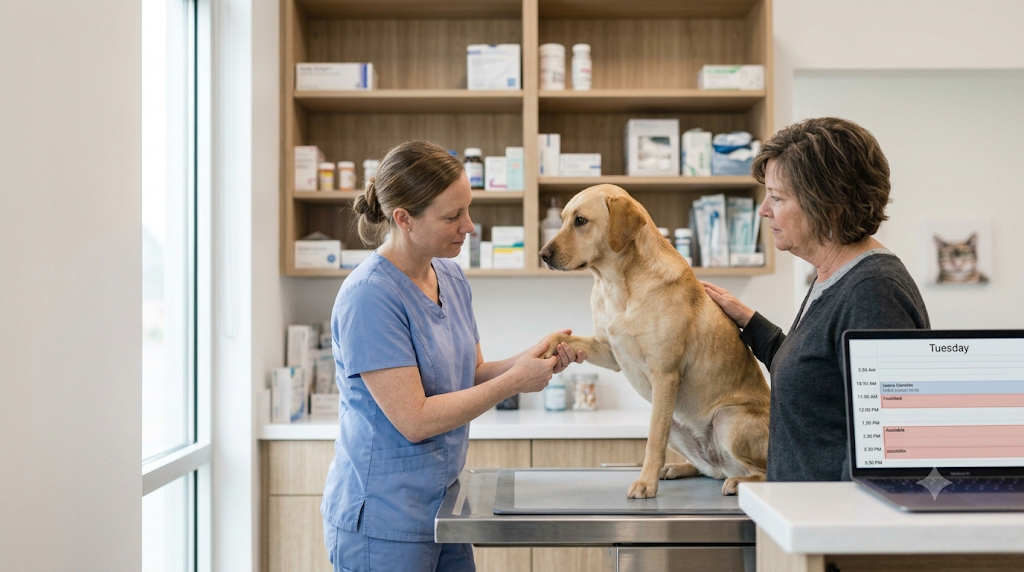


It is 10 p.m. on a Tuesday. Your clinic is dark, the phones are off, and somewhere across Geneva a pet owner just tried to book an appointment for Wednesday morning. They could not get through. They may try again tomorrow, or they may call the clinic down the street that added an online booking link to their website last month. Either way, Wednesday’s 9 a.m. slot stays empty, and you will not know it happened until you look at a half-full schedule and wonder where the morning went.
That is the cost of a phone-only booking system: not one missed call, but a structural gap that opens every evening, every weekend, and every lunch hour your team is too busy to answer. The question this article addresses is not whether you should add online booking. It is which parts of your day you actually want to keep doing by phone, and which ones you can hand off to a system that works while you sleep.
What a Tuesday night booking reveals about your phone system
A booking attempt at 10 p.m. is not unusual. Working pet owners in Zurich, Lausanne, and Basel think about their pet’s health in the evening, after the kids are in bed, when they finally have a quiet moment. A phone-only clinic is structurally invisible at that moment.
The cost compounds quickly. Every unanswered evening attempt, every lunch-hour call that rings out, every Saturday morning enquiry that goes to voicemail is either a booking that lands with a competitor or a client who delays care. Neither outcome shows up in your call log because the call was never answered. According to digital health research, the majority of patients now expect to book appointments outside standard business hours, and clinics that cannot meet this expectation lose bookings silently.
Online booking does not change what happens during your open hours. It adds a parallel channel that operates when your team cannot, without requiring anyone to stay late or monitor a screen.
What actually changes when online booking goes live
The first calls to migrate online are routine new appointment requests and availability checks. These are the highest-volume, lowest-complexity contacts in a front-desk day: a client wants to know if there is a slot on Thursday afternoon, or needs to book an annual vaccination. These interactions require no clinical judgment, but they interrupt everything else your reception team is trying to do.
Research on online appointment scheduling in clinical settings shows meaningful reductions in administrative call load when the new channel is actively promoted. Reviews of digital scheduling adoption point in the same direction. Results depend on how consistently the clinic directs clients to the new channel, so the shift is not automatic.
Automated reminders are the mechanism behind no-show reduction, not the booking channel itself. When a client books online and receives an SMS reminder 24 hours before their appointment, they are more likely to show up or cancel in time for the slot to be refilled. Digital health educators consistently note that automated reminders reduce missed appointments across clinical settings. For a 3-vet clinic, the shared veterinary calendar becomes the operational hub. Real-time calendar sync enforces availability across all vets simultaneously, so double-bookings drop because the system prevents them at the point of booking, not after the fact.
Ready to see the before/after picture for your clinic?
OneClic.vet offers a free trial sized for independent Swiss clinics: explore the platform at your own pace before committing to anything. Start your free trial
Which calls should stay on the phone
Not every contact type belongs online. A hybrid model works because it assigns each call type to the channel best suited to handle it.
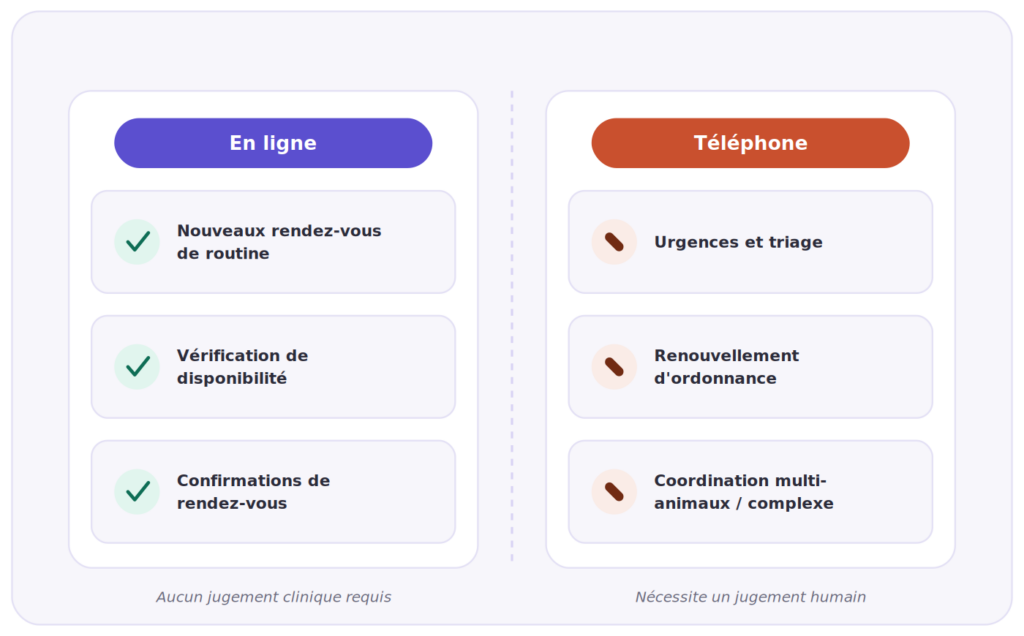
- Routine new appointment booking moves online. This is the highest-volume, lowest-complexity category. The system handles availability, confirmation, and reminders automatically.
- Emergency and urgent triage stays on the phone, without exception. Online booking platforms are not designed for emergency assessment. If a client’s dog has been hit by a car or a cat is in respiratory distress, they need to speak to a person who can assess urgency and direct them appropriately.
- Prescription callbacks and medication refill requests stay on the phone. These require clinical judgment about whether a refill is appropriate, what dosage applies, or whether the animal needs to be seen first.
- Complex or multi-pet coordination stays on the phone. Appointments involving multiple animals, specialist referrals, or unusual scheduling constraints benefit from a human conversation so the vet has the context they need before the appointment.
The hybrid model is not a compromise. It is the correct operational design: automate what does not require judgment, and protect the phone line for everything that does.
Will online booking replace your receptionist?
No. But the honest answer is more specific than that.
The calls that move online require no human judgment: availability checks, routine bookings, appointment confirmations. These are also the calls that consume the most time. A reception team fielding 50 calls per day and handling 30 routine bookings by phone spends more than half its call time on tasks a platform can handle. That time does not disappear when it migrates online: it reallocates to work that cannot be automated.
What remains when routine scheduling migrates is more demanding and more visible. Triage calls, client relationship management, and complex case coordination are not reduced responsibilities. They are more skilled ones. The in-clinic experience that determines whether a client returns depends entirely on the team, not the platform.
Internal resistance is a real risk and should be named directly. If your team perceives the platform as a threat to their roles, adoption will stall regardless of how good the software is. Show them what moves online. Show them what stays with them. The list of what stays is longer and more interesting.
Managing the first 90 days with your clients
Call volume does not drop on day one. The transition period is real, and you should expect some clients to call during the first few weeks to ask how the new system works. This is normal and temporary.
Three low-effort tools accelerate client adoption. Signage at the front desk with a QR code linking to the booking page removes the friction of finding the URL. A hold-message script that mentions online booking catches clients who are already on the phone. A short line on appointment confirmation emails (« Book your next visit online at any time ») plants the idea without requiring any action at that moment. Practice growth research shows that clinics actively directing clients to a digital booking channel see faster adoption than those who add a link to their website and wait.
Clients who prefer phone contact are not a problem to solve. The phone lines stay open. The goal is to give clients who want to book at 10 p.m. a way to do so, while keeping the phone available for everyone else.
For a Swiss clinic with a linguistically diverse client base, the transition is easier when the booking flow works in French, German, Italian, and English. A multilingual interface removes a real barrier for clients who might otherwise default to a phone call because they are not confident in a second language.
What to look for in a booking platform for Swiss clinics
Choosing a platform for a Swiss independent clinic comes down to four criteria that matter more than feature depth. Here is what to evaluate before committing to a trial.
- Multilingual client-facing booking. A platform that handles French, German, Italian, and English removes a real barrier for a linguistically diverse Swiss client base. This is not optional for most clinics outside single-language urban areas.
- Data residency and consent management. Ask any vendor directly: where is client data stored, and how is consent captured and documented? These two criteria determine compatibility with the Swiss nFADP and EU GDPR framework. Do not assume compliance from marketing materials.
- Calendar sync and onboarding speed. For a 1 to 5 vet clinic, a platform that syncs with Google, Outlook, or iCal and can be configured in a single afternoon matters more than an extensive feature list. A 15 to 30 minute training time and a go-live within 1 to 2 weeks means the team sees benefit before setup fatigue sets in.
- A free trial with real availability. The lowest-risk evaluation path is testing the booking flow with your actual schedule before committing to a subscription. A 14 to 30 day free trial is enough time to see whether clients use it and whether the calendar sync works with your existing setup.
A platform that meets all four criteria is worth trialling. One that fails on data residency or multilingual support is not the right fit for a Swiss clinic, regardless of its other features.
See if OneClic.vet fits your clinic before you commit
OneClic.vet is built for independent Swiss practices: multilingual booking, GDPR-aligned data handling, and a setup that takes an afternoon, not a week. See how it works for your clinic
Frequently asked questions
These questions come up consistently when clinic owners evaluate the switch to hybrid booking. The answers below address the operational and compliance concerns most relevant to Swiss independent practices.
Will online booking replace my receptionist?
No, and the operational case is straightforward. Routine scheduling calls, availability checks, and appointment confirmations move online because they require no human judgment. What remains is triage, client relationship management, complex case coordination, and the in-clinic experience that determines whether a client returns. These are more skilled responsibilities, not fewer. The platform removes the interruption layer; it does not remove the role.
What happens to clients who prefer to call?
Phone lines stay open. Online booking is an added channel, not a replacement. Clinics that add online booking typically see routine scheduling calls fall over time while urgent and complex calls continue at similar volumes. Clients who prefer phone contact are a segment to retain, not a problem to solve. The design goal is to give evening and weekend bookers a way in, not to close the phone line.
How long does it take for clients to start booking online?
A realistic range is several weeks to a few months, depending on the age profile of your client base and how actively you promote the new channel. Clinics that use front-desk signage, a hold-message script, and a line on confirmation emails from day one see faster adoption than those that add a link to their website and wait. There is no single percentage that applies across all clinics.
Can I still handle emergencies through the system?
Emergency triage must remain phone-first, without exception. Online booking platforms are not designed for emergency assessment. If a client’s animal needs urgent care, they need to speak to a person who can assess the situation and direct them appropriately. Your booking page should never be presented as an emergency contact channel. This is a patient-safety boundary, not a software limitation.
How does online booking affect no-show rates?
Automated reminders are the mechanism, not the booking channel alone. When clients receive an SMS or email reminder 24 hours before their appointment, they are more likely to show up or cancel in time for the slot to be refilled. Clinical evidence consistently shows that automated reminders reduce missed appointments in clinical settings. The size of the effect depends on reminder timing, client demographics, and follow-up protocol.
Is online booking GDPR-compliant for a Swiss clinic?
The Swiss nFADP and EU GDPR framework both apply to how client data is collected, stored, and processed. Data residency and consent management are the two criteria to verify with any vendor: ask where client data is stored and how consent is captured and documented. Do not accept a vendor’s marketing claim as legal confirmation. If you are uncertain, involve legal review before committing to a platform.
How much does it cost to add online booking to a small clinic?
For the Swiss market, expect a range of roughly CHF 99 to 299 per month depending on the number of vets and the feature set required. Starter plans for a 1 to 2 vet clinic tend toward the lower end of that range. Most platforms offer a free trial period of 14 to 30 days, which is enough time to test the booking flow with real clients before committing to a subscription. Confirm pricing directly with the vendor, as plans vary by feature tier.