

You already know no-shows are a problem. You see the empty slots, you hear the phones that didn’t ring back, and you watch your reception team scramble to fill gaps at the last minute. What you probably don’t have is a CHF figure on any report that tells you exactly what those empty slots cost you each year.
That gap between « I know this is a problem » and « I can prove it costs me X francs a year » is exactly what this article closes. Here is the three-step calculation that gets you there.
How to calculate your no-show rate
Your no-show rate is the starting point.Artera’s scheduling research puts the general healthcare benchmark at around 18%, though that figure covers a broad range of clinical settings and is not a veterinary-specific number. Veterinary practices typically run lower, with European and U.S. benchmarks showing averages of 10–18% and well-run clinics targeting under 8%. Use the 18% figure as a reference point for the worked example below, not as a veterinary target.
Pull your numbers from your booking log, calendar export, or front-desk tally sheet for any given month. Then follow these three steps.
Step 1: Count the total number of appointments scheduled for the month, including all booked slots regardless of outcome.
Step 2: Count the appointments where the client did not attend and did not contact the clinic in advance.
Step 3: Divide missed appointments by total scheduled appointments, then multiply by 100.
Your no-show rate formula:
(Your monthly missed appointments ÷ your total scheduled appointments) × 100 = your monthly no-show rate (%)
Example: 216 missed appointments ÷ 1,200 total scheduled appointments × 100 = 18%
Once you have that percentage, you have the input you need for the next calculation.
What that percentage costs in CHF: a worked example
Now convert the percentage into a CHF figure. The assumptions below are clearly labeled so you can substitute your own numbers.
Assumptions for this example:
- 3-vet Swiss clinic
- 1,200 appointments per month
- CHF 150 average visit fee (substitute CHF 120 or CHF 180 if your fee structure differs)
- 18% no-show rate, used for illustration only
The arithmetic:
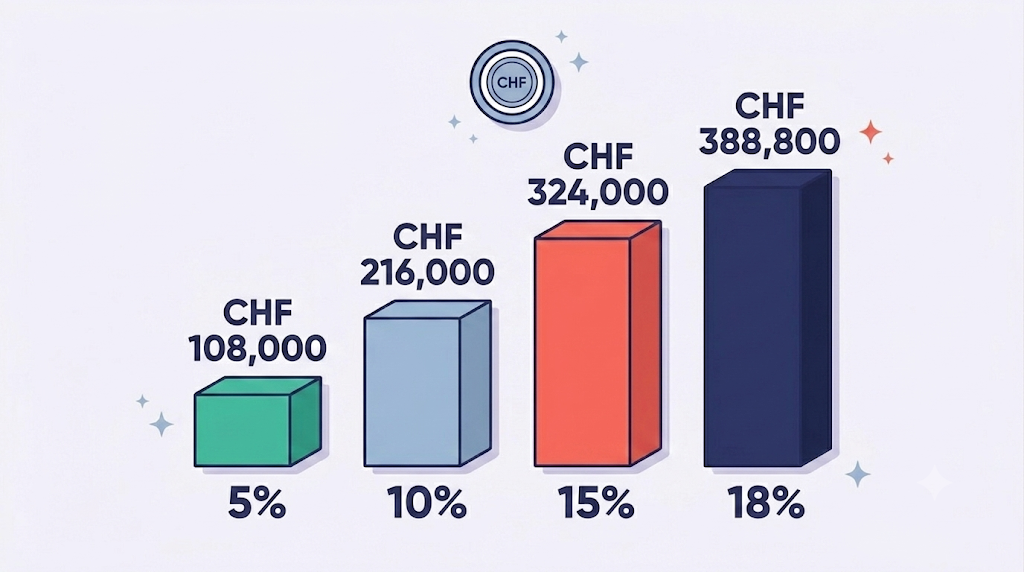
18% of 1,200 appointments = 216 missed slots per month
216 missed slots × CHF 150 = CHF 32,400 per month in direct revenue loss
CHF 32,400 × 12 months = CHF 388,800 annual direct revenue leakage
That figure will look different at your clinic. If your average visit fee is CHF 130 and your no-show rate is 12%, your monthly leakage is closer to CHF 18,720, or roughly CHF 224,640 per year. As PetDesk’s veterinary revenue analysis and CS Vets’ per-vet leakage model both show, the annual figure compounds quickly once you account for appointment volume.
Take 60 seconds now: run your own numbers through the formula above. The CHF figure you land on is what the next two sections will help you understand fully.
The hidden costs your P&L does not show
The direct revenue figure is only part of the picture. Two additional cost layers make the real total meaningfully larger, and neither appears on a standard P&L.
Staff idle time. When a slot goes empty, your reception team still spent 5–10 minutes on that appointment: confirmation calls, check-in prep, and follow-up. At a Swiss front-desk wage of roughly CHF 25–30 per hour, that is a directional estimate of CHF 2–5 per no-show. Applied to the 216-slot example, that adds CHF 430–1,080 per month in untracked staff cost.
Peak-slot opportunity cost. An empty 9 AM or Saturday morning slot cannot be recovered. Unlike a slow midweek gap where a walk-in might partially fill the space, high-demand windows are permanently lost the moment the client fails to arrive. PMC’s peer-reviewed research on scheduling operations confirms that no-show-driven capacity loss creates compounding operational drag, not just a one-time revenue miss.
Downstream rebooking friction. Staff time spent chasing cancellations, filling gaps, and managing waitlists is real overhead that never appears as a line item. Add these layers together and the CHF figure you calculated earlier is likely an undercount.
See how the booking and reminder layer works for a clinic your size.
OneClic.vet’s scheduling and automated reminder tools are built specifically for independent Swiss clinics, not as a PMS replacement but as the booking layer that sits alongside your existing systems. See how it works
How does your clinic compare? No-show rate benchmarks
No verified Swiss veterinary no-show baseline exists in public literature. The benchmarks below are drawn from European veterinary and broader healthcare proxies and should be read as directional guidance, not prescriptive Swiss norms.
- 5–10%: Watch-and-monitor range. Your scheduling practices are broadly functional, but tracking the trend matters. This band does not require immediate intervention, but it does require consistent measurement.
- 10–15%: Closer look warranted. Review your reminder process and booking confirmation workflow. Most independent clinics sit here before putting a scheduling layer in place.
- 15%+: Act-now signal. At this level, the annual CHF leakage is large enough to justify a dedicated scheduling intervention. The revenue math closes quickly against the cost of a fix.
ezyVet’s veterinary benchmark guidance and Solutionreach’s national average analysis both support these thresholds as a reasonable starting framework. Top-performing clinics consistently track under 8%. Clinics that rely on phone-based booking and manual confirmation calls tend to sit at the higher end of the range.
Three scheduling levers that close the gap
These are booking and reminder fixes, not full system replacements. You can implement all three at the scheduling layer without touching your existing practice management software.
- Automated SMS and email reminders. A reminder sent 48 hours before the appointment, followed by a second one 24 hours out, is the single highest-impact change you can make. Based on European healthcare and veterinary practice data, this produces a realistic reduction of 20–40% fewer no-shows. For the 216-slot example, that means recovering 43–86 appointments per month before any other change is made. You can explore how [automated reminders](INTERNAL: No clusters defined) work as a scheduling layer for Swiss clinics.
- Online booking availability. When clients can book at 10 PM on a Sunday, you capture demand that would otherwise go to a competitor or simply not convert. Clients who self-book are also less likely to forget, because choosing the slot creates a stronger commitment. The Vetport revenue analysis confirms that reducing friction at the booking stage is one of the most consistent levers available to independent practices.
- Waitlist and rebooking logic. A live waitlist means a cancelled slot can be filled within minutes rather than sitting empty. Even filling 30–40% of cancelled slots materially reduces your monthly leakage figure. This is the lever most clinics have not yet implemented, and it requires the least change to existing workflows.
These three levers work together. Reminders reduce no-shows at the front end. Online booking increases commitment at the point of reservation. Waitlist logic recovers slots that still fall through.
Turning your CHF loss figure into a decision
You now have a CHF annual leakage figure. The decision is a simple comparison: weigh your annual revenue loss against the monthly cost of a scheduling layer. For a 1–5 vet clinic, that layer runs CHF 99–299 per month.
A realistic recovery target with reminders and online booking is 20–30% of missed slots. For the 216-slot example, recovering 20% means filling roughly 43 appointments per month, or CHF 6,480 in recovered revenue against a tool cost of CHF 99–299. The math closes in the first quarter.
Not all no-shows are recoverable. But the question is not whether you can eliminate them entirely: it is whether the recoverable portion justifies the cost of the scheduling layer. For most independent Swiss clinics, it does. Write down your annual leakage figure and compare it to the cost of one subscription. If you want to see what changes move the needle first, a [scheduling efficiency review](INTERNAL: No clusters defined) walks through the approach clinic by clinic.
Ready to put a CHF figure on your scheduling gap?
OneClic.vet’s booking and reminder layer is designed for independent Swiss clinics that want to reduce no-shows without replacing their existing practice management system.
Book a demo
Frequently asked questions
What is a good no-show rate for a veterinary clinic?
A rate of 5–10% is a watch-and-monitor range for most veterinary practices. Rates above 15% are a clear signal to act. No verified Swiss veterinary-specific baseline exists in public literature, so these thresholds are drawn from European veterinary and broader healthcare proxies. Treat them as directional guidance rather than a certified Swiss benchmark.
How do I calculate my clinic’s no-show rate?
Use this formula: missed appointments ÷ total scheduled appointments × 100. Pull your missed appointment count and total scheduled appointments from your booking log, calendar export, or front-desk tally sheet for any given month. The result is your monthly no-show rate as a percentage. Repeat the calculation over three to six months to identify a trend rather than a single outlier.
How much revenue does a 10% no-show rate cost a Swiss vet clinic per year?
Using 800 appointments per month and a CHF 150 average visit fee: 10% of 800 = 80 missed slots per month. 80 × CHF 150 = CHF 12,000 per month. CHF 12,000 × 12 = CHF 144,000 per year in direct revenue loss. Clinics with different appointment volumes or fee structures should substitute their own figures into the same formula.
Does the cost of no-shows include staff time, or just lost fees?
Direct revenue loss is only part of the picture. Staff idle time spent on confirmation calls and check-in prep adds a directional cost of CHF 2–5 per empty slot, and downstream rebooking friction adds further untracked overhead. These are estimates, not auditable accounting figures. The hidden-costs section above explains the full model.
Can automated reminders actually reduce no-shows, and by how much?
Yes. Based on European healthcare and veterinary practice data, SMS and email reminders sent 48 and 24 hours before an appointment produce a realistic reduction of 20–40% fewer no-shows. This is a scheduling-layer fix, not a clinical tool, and the actual reduction at your clinic will depend on your client mix and current reminder practices.
What is the difference between a no-show and a late cancellation?
A no-show is a client who does not attend and does not contact the clinic. A late cancellation is a client who cancels with insufficient notice to fill the slot, typically under 24 hours. Both carry similar slot-loss risk because the gap in your schedule cannot be filled in time. Track both together for an accurate picture of your total appointment loss rate.
Should I charge a no-show fee?
A no-show fee can reduce repeat offences, but it is a policy decision, not a scheduling fix. Fees work best when communicated clearly at the time of booking and applied consistently. For most independent Swiss clinics, the higher-leverage first step is reducing no-shows before they happen through reminders and online booking, rather than recovering cost after the fact through fees.
Your CHF figure is now a decision, not a suspicion
The no-show rate is no longer an abstract percentage. It is a CHF figure you can write down, show to a business partner, and compare directly to the cost of fixing it. The math is done. The next step is proportionate and low-risk: not a full system overhaul, but a scheduling layer that handles reminders and online booking automatically.
If you have your annual leakage figure in hand, see what that scheduling layer looks like in practice. Book a demo and we will walk through it for a clinic your size.